
NPTEL Natural Language Processing Week 10 Assignment Answers 2024
1. Common Steps of Entity Linking are –
Options:
- A) Reference Disambiguation → Candidate Selection
- B) Reference Disambiguation → Candidate Selection → Mention Identify
- C) Mention Identify → Candidate Selection → Reference Disambiguation
- D) All of the above
✅ Answer: C
Explanation:
Entity Linking follows this correct order: Mention Identification → Candidate Selection → Reference Disambiguation.
2.
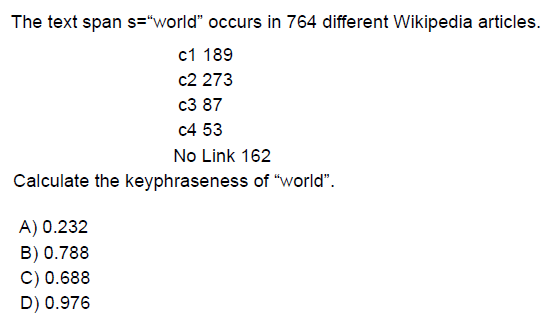
✅ Answer: B
3. What is the commonness of (s, c₂) in the above question?
Options:
- A) 0.765
- B) 0.389
- C) 0.453
- D) 0.910
✅ Answer: c
Explanation:
Commonness typically refers to the probability that a surface form s refers to candidate entity c₂.
4. Higher value of keyphraseness represents higher probability of:
Options:
- A) An article to get selected as linkable candidate
- B) A phrase to get detected as a mention
- C) An article to get disambiguated from other candidates
- D) None of the above
✅ Answer: b
Explanation:
Keyphraseness measures how likely a phrase is a named entity mention.
5. Which of the following problems exist in bootstrapping technique for Information Extraction?
Options:
- A) Sensitiveness towards the seed set
- B) High precision
- C) Less manual intervention
- D) All of the above
✅ Answer: a
Explanation:
Bootstrapping heavily relies on the quality and bias of the initial seed set, making it sensitive to errors.
[tutor_course id=”26102, 2742″ exclude_ids=”” category=”” orderby=”ID” order=”DESC” count=”6″]
6. Which of the following is an advantage of unsupervised relation extraction?
Options:
- A) Can work efficiently with small amount of hand-labeled data
- B) Not easily generalizable to different relations
- C) Need training data
- D) Always perform better than supervised techniques
- E) None of the above
✅ Answer: e
Explanation:
None of the above are advantages. Unsupervised relation extraction is hard to evaluate, often less accurate.
7. Which of the following is/are a Hearst’s Lexico-Syntactic Pattern for automatic acquisition of hyponyms?
Options:
- A) X or other Y
- B) X and other Y
- C) Y including X
- D) X but not Y
✅ Answer: a, b, c
Explanation:
Hearst patterns help extract hyponym-hypernym relationships. Examples include:
- “such as”,
- “including”,
- “and other”,
- “or other”.
8. Advantage of Distant Supervision over Bootstrapping method
Options:
- A) Need more data
- B) Less human effort
- C) Can handle noisy data better
- D) No Advantage
✅ Answer: c
Explanation:
Distant Supervision is more robust in handling noise, especially when labeled data is noisy or incomplete.
9. For a dataset with few but important relations, the most useful metric is:
Options:
- A) Precision
- B) Recall
- C) Accuracy
- D) F1-Score
✅ Answer: b
Explanation:
In scenarios where missing important relations is critical, Recall is prioritized to capture as many as possible.
10. Bootstrapping can be considered as:
Options:
- A) Supervised Approach
- B) Unsupervised Approach
- C) Semi-supervised Approach
- D) All of the above
- E) None of the above
✅ Answer: c
Explanation:
Bootstrapping starts with a small labeled set (supervised) and grows using unlabeled data, making it semi-supervised.